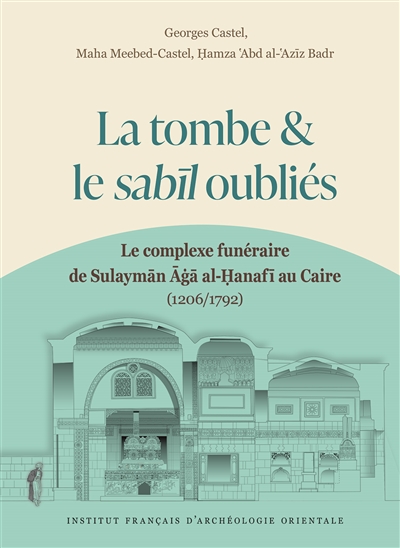
La tombe & le Sabil oubliés : le complexe funéraire de Sulayman Aga al-Hanafi au Caire (1206-1792)
Cet ouvrage à plusieurs mains est le premier travail consacré à la tombe et au sabil de l'émir Sulayman Aga al-Hanafi, un des lieutenants d'Ibrahim Bay al-Kabir (m. 1817), le gouverneur de l'Égypte avant l'expédition de Napoléon Bonaparte. Outre qu'il fournit une description précise de l'architecture et de la décoration de ces deux bâtiments, construits à la fin du XVIIIe siècle dans le cimetière d'al-Abagiyya au Caire, il présente l'ensemble de leurs inscriptions, en arabe et en traduction française, ainsi que l'acte légal par lequel cet ensemble funéraire a été établi en waqf et qui est publié ici également dans les deux langues.
Doté d'une riche iconographie grâce à de nombreux dessins et photographies des différentes parties des deux bâtiments et de leurs inscriptions, La tombe et le sabil oubliés enrichit notre connaissance des monuments funéraires musulmans de l'Égypte ottomane. Il ne manquera pas d'intéresser les historiens, les philologues et les architectes mais aussi des « lecteurs profanes » qui portent un intérêt aux coutumes religieuses, à l'architecture islamique ou à la langue juridique en Égypte à l'époque moderne. Puisse-t-il, en dévoilant la richesse de l'architecture de ce monument funéraire, la qualité de sa décoration et la beauté de ses inscriptions, aider à conserver une part de l'histoire égyptienne à l'époque ottomane.
This multi-authored work is the first study devoted to the tomb and sabil of Emir Sulayman Aga al-Hanafi, one of the lieutenants of Ibrâhim Bay al-Kabir (d. 1817), the governor of Egypt before Napoleon Bonaparte's expedition. In addition to providing a detailed description of the architecture and decoration of these two buildings, constructed at the end of the 18th century in the al-Abagiyya cemetery in Cairo, it presents all of their inscriptions, in Arabic and French translation, as well as the legal document establishing this funerary complex as a waqf, which is also published here in both languages.
With its rich iconography, including numerous drawings and photographs of the different parts of the two buildings and their inscriptions, La tombe et le sabil oubliés enriches our knowledge of Muslim funerary monuments in Ottoman Egypt. It will be of interest not only to historians, philologists and architects, but also to 'lay readers' with an interest in religious customs, Islamic architecture or legal language in Egypt in the modern era. By revealing the richness of this funerary monument's architecture, the quality of its decoration and the beauty of its inscriptions, it may help to preserve a part of Egyptian history during the Ottoman period.